
Tendon and ligament pain has a way of outlasting everything thrown at it. Ice, rest, ibuprofen, a cortisone shot, a few months of physical therapy, and then the first heavy lift or long round of golf brings it right back. Two peptides keep coming up in that conversation: BPC-157 and TB-500. Taken together, people call them the "Wolverine stack." This guide shows, step by step and in motion, what the research says happens inside a healing tendon and where each peptide is thought to fit.

Why tendons and ligaments heal so slowly
It comes down to blood. Muscle is packed with blood vessels, which is why a pulled hamstring usually heals in weeks. Tendons and ligaments have a much poorer blood supply, and cartilage has almost none. Fewer vessels means fewer repair cells, less oxygen and fewer building blocks reaching the injury, so the damage can linger for months or years.
That is the story behind golfer's elbow, tennis elbow, a cranky rotator cuff or a patellar tendon that aches on stairs. The tissue is frayed, and it is not getting what it needs to rebuild.
Why the usual fixes often wear off
Anti-inflammatories turn down the alarm, but they do not rebuild torn fibers. Cortisone shots can calm a flare-up for a few weeks, yet a large systematic review in The Lancet found that for tennis elbow, people who received corticosteroid injections did worse at one year than people who took a wait-and-see approach.5 Managing the signal is not the same as repairing the tissue.
How tendon repair works, animated
Most of the research below comes from laboratory and animal studies, and human research is still developing. The proposed sequence is what makes these two compounds stand out. The animation walks through it in four steps.
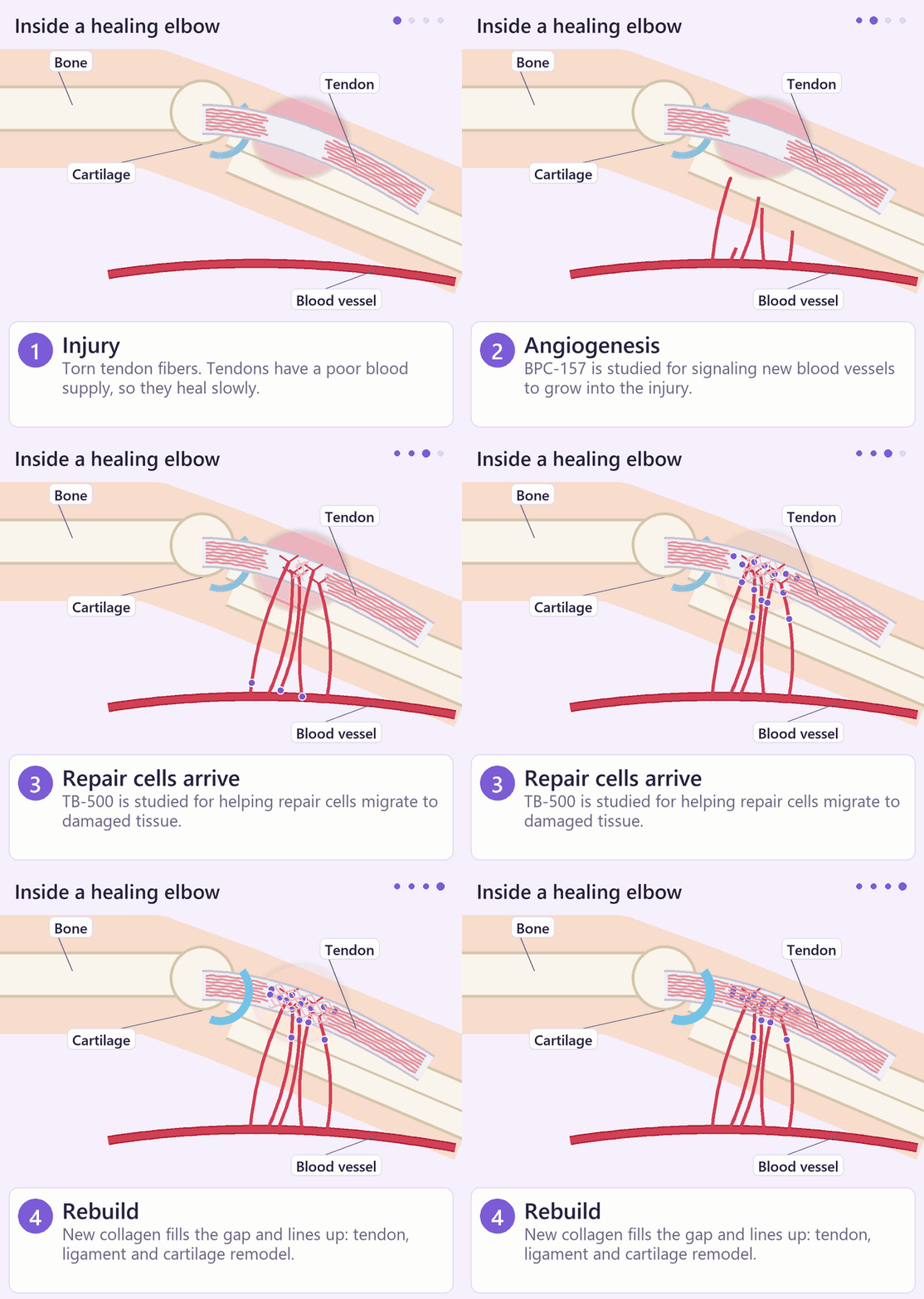
1. Injury: torn fibers and poor blood supply
A tendon under repeated strain develops small tears. With little blood flow, the repair crew arrives slowly, and the fibers that do form are often disorganized.
2. Angiogenesis: BPC-157 is studied for growing new blood supply
Angiogenesis is the body building new capillaries. In laboratory research, BPC-157 activated and up-regulated VEGFR2, the main receptor that tells blood vessels to sprout.2 That matters most in the places that heal worst: tendons, ligaments and the tissue around cartilage. In a study in the Journal of Applied Physiology, BPC-157 also increased the outgrowth, survival and migration of tendon fibroblasts, the cells that lay down new tendon tissue.1 In a rat model of a torn knee ligament, it improved healing measured by function, strength and tissue structure.3
3. Repair cells arrive: TB-500 is studied for cell migration
TB-500 is a synthetic fragment of thymosin beta-4, a protein your own body makes. Thymosin beta-4 regulates actin, the scaffolding cells use to move, so it has been studied for helping repair cells migrate into damaged tissue, for new blood-vessel growth and for calming inflammation.4 Where BPC-157 is thought of as targeted, strongest near the injury, TB-500 is thought of as whole-body.
4. Rebuild: new collagen lines up
With blood supply and repair cells in place, new collagen fills the gap and lines up along the direction of pull. A 2019 review of the musculoskeletal research described the same pattern across tendon, ligament, muscle and bone.6
Why BPC-157 and TB-500 are paired
One is studied for local repair and the other for systemic repair, so their proposed mechanisms are complementary rather than overlapping. That is why the two are so often discussed together, and why the combination picked up the nickname "Wolverine stack." The nickname is colloquial, not a product name or a clinical term.
| Option | Best fit | Price |
|---|---|---|
| BPC-157 + TB-500 Stack | Targeted and whole-body support at once; more than one sore area | $249 / month |
| BPC-157 | One stubborn spot: an elbow, a shoulder, a knee | $179 / month |
| TB-500 | Aches in several places and overall recovery | $179 / month |
A licensed provider helps decide which option, if any, fits your history.

Where people are asking about it
The common thread is tissue with a poor blood supply that has stopped healing on its own:
- Elbows: tennis and golfer's elbow, frayed forearm tendons.
- Shoulders: rotator cuff tendons, the ache reaching overhead or sleeping on your side.
- Knees and hips: patellar tendons, ligaments and the cartilage that cushions the joint.
- Back and neck: strained ligaments and the connective tissue that supports the spine.
- Old injuries: the sprain, tear or surgery that healed but never felt right again.
How to get BPC-157 and TB-500 safely
BPC-157 and TB-500 are not sold over the counter, and "research use only" peptides sold online are not made for people and can be mislabeled. Through Biotech Lifestyle the process happens from home:
- Answer a short online questionnaire about where it hurts, how long, what you have tried and your medical history.
- A licensed provider reviews your answers. If a peptide protocol is appropriate, the provider writes the prescription. If it is not, they will tell you.
- It ships to your door from a licensed U.S. compounding pharmacy, with dosing instructions and ongoing provider support.
See if you qualify for the BPC-157 + TB-500 stack. A licensed provider decides whether peptide therapy is appropriate for you; completing the evaluation does not guarantee a prescription.
Safety information
BPC-157 and TB-500 are not approved by the FDA to treat any condition. Most published research on them is preclinical, and human clinical data is limited. They may cause side effects, including injection-site reactions, and their long-term safety in people has not been established. They are not appropriate for everyone, including people who are pregnant or breastfeeding or who have, or have had, cancer. Compounded medications are not FDA-approved; they are prepared by licensed compounding pharmacies for individual patients and may differ in safety, effectiveness and quality from FDA-approved products.
References
- Chang CH, et al. (2011). The promoting effect of pentadecapeptide BPC 157 on tendon healing involves tendon outgrowth, cell survival, and cell migration. Journal of Applied Physiology, 110(3), 774-780. PubMed
- Hsieh MJ, et al. (2017). Therapeutic potential of pro-angiogenic BPC157 is associated with VEGFR2 activation and up-regulation. Journal of Molecular Medicine, 95(3), 323-333. PubMed
- Cerovecki T, et al. (2010). Pentadecapeptide BPC 157 (PL 14736) improves ligament healing in the rat. Journal of Orthopaedic Research, 28(9), 1155-1161. PubMed
- Goldstein AL, et al. (2012). Thymosin beta4: a multi-functional regenerative peptide. Expert Opinion on Biological Therapy, 12(1), 37-51. PubMed
- Coombes BK, Bisset L, Vicenzino B. (2010). Efficacy and safety of corticosteroid injections and other injections for management of tendinopathy. The Lancet, 376(9754), 1751-1767. PubMed
- Gwyer D, Wragg NM, Wilson SL. (2019). Gastric pentadecapeptide body protection compound BPC 157 and its role in accelerating musculoskeletal soft tissue healing. Cell and Tissue Research, 377(2), 153-159. PubMed